

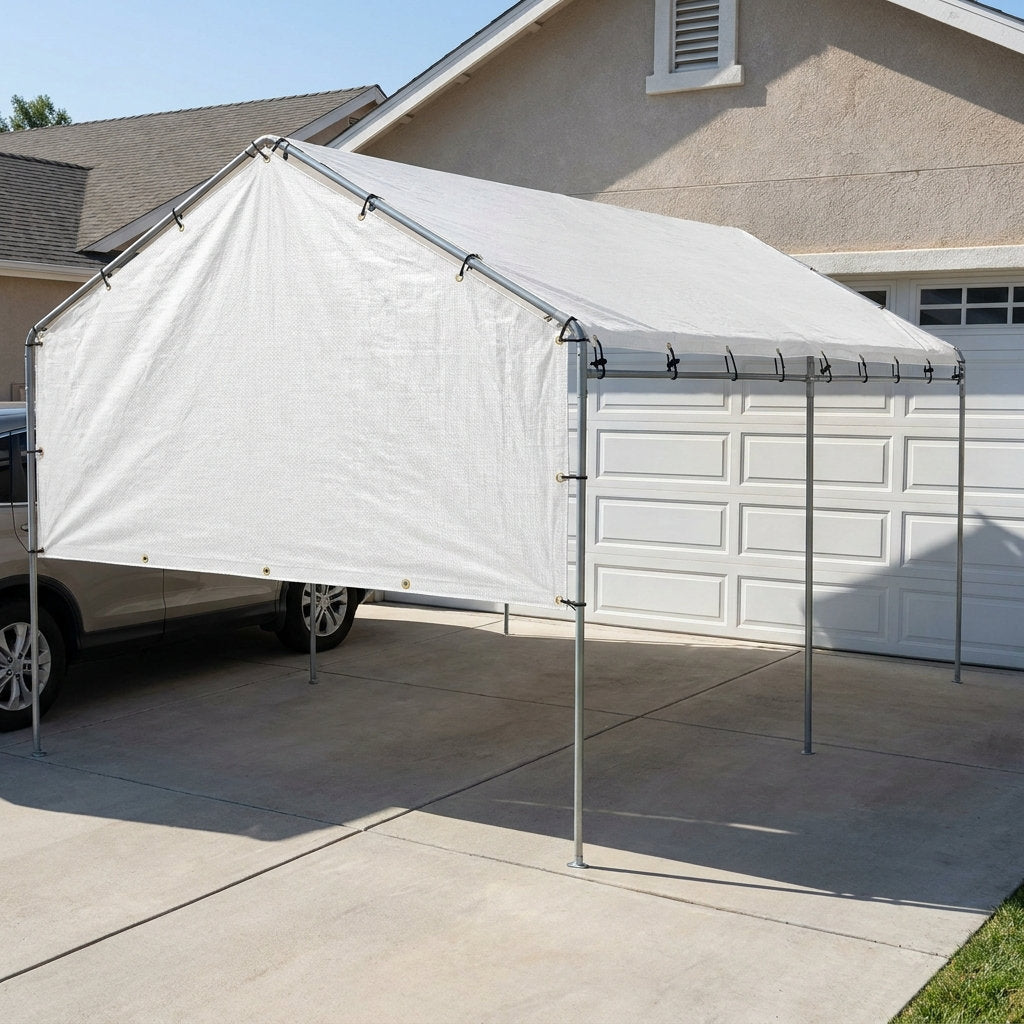
When you compare poly tarps online, you'll see two very different numbers used to describe "how heavy duty" a tarp is: mil and ounces per square yard (oz/yd²). They measure different things — and because there's no spec police on the internet, some listings quietly inflate one of them to make a thinner tarp look tougher than it is. This guide explains what each number means, how they relate, and how to check a spec sheet in about ten seconds.
What "mil" means
A mil is a unit of thickness: one mil equals 1/1,000 of an inch (0.001"). It is not a millimeter. The higher the mil, the thicker the material:
- 5 mil – light / regular duty (most economy blue tarps)
- 8 mil – mid heavy duty
- 10 mil – true heavy duty
- 12–16 mil – super heavy duty
What "oz per square yard" means
Ounces per square yard is areal weight — how much one square yard of the fabric weighs. Because thicker material uses more polyethylene, weight and thickness move together. For woven poly tarps the rule of thumb is roughly 0.5 to 0.55 oz/yd² for every mil of thickness.
That gives a quick reference chart:
| Thickness | Typical finished weight |
|---|---|
| 5 mil | ~2.4–2.75 oz/yd² |
| 6 mil | ~3.0–3.3 oz/yd² |
| 8 mil | ~4.0–4.4 oz/yd² |
| 10 mil | ~5.0–5.5 oz/yd² |
| 12 mil | ~6.0–6.6 oz/yd² |
| 16 mil | ~8.0–8.8 oz/yd² |
(Approximate — exact weight varies with weave count, denier, and lamination, but real products stay close to this band.)
How much does a 10 mil tarp weigh?
A true 10 mil woven poly tarp weighs about 5.5 oz per square yard.
To turn that into a real number, multiply by the tarp's area. A 30' × 40' tarp covers 1,200 sq ft, which is 133.3 sq yd:
133.3 sq yd × 5.5 oz/yd² ≈ 733 oz ≈ 46 lb
So a genuine 10 mil 30' × 40' tarp weighs roughly 45–46 pounds before packaging. If a listing of similar size claims a number wildly different from this, dig deeper.
How to spot an overstated spec
Here's the ten-second check. Multiply the stated mil by ~0.5–0.55. If the listed oz/yd² is much higher than that, the two numbers contradict each other — and one of them is wrong.
Example of an impossible spec: an 8 mil tarp advertised at 6 oz/yd². Run the math: 6 ÷ 0.55 ≈ 11 mil. In other words, that "8 mil" tarp would have to be thicker than a true 10 mil to weigh that much. It can't be both. Either the thickness is understated or — far more commonly — the weight is inflated to look heavy duty.
You'll most often see this on bargain listings that quote a low mil (which is cheap to manufacture) but borrow a heavy oz figure from a thicker product.
Why this matters when you buy
Thickness and weight are the difference between a tarp that survives a season and one that shreds in the first windstorm. Two more things to verify alongside them:
- Weave count (e.g., 12×12 vs. 14×14) — more threads per inch means better tear resistance.
- Finished size vs. cut size — a "cut size" tarp is measured before hemming and usually arrives 3–5% smaller than advertised. A finished size tarp is measured after hemming, so what you order is what you get.
A spec sheet that lists a consistent mil and weight, a true finished size, and an honest weave count is a sign you're dealing with a seller who isn't rounding the truth in their favor.
Shop true-spec heavy duty white tarps
MyTarp's Sigman 30' × 40' Heavy Duty White Tarp is a true 10 mil, 14×14 weave, finished-size woven poly tarp — UV-coated on both sides with rust-resistant grommets every ~18". Browse the full range of Heavy Duty White Tarps for every size from 5×7 to 40×60.

